

What Is A Pediatric Registered Nurse
Pediatric nurses provide health and medical care for children from birth through their late teens. These nurses have special training to provide expert intendance to the kid while working with the family unit to address their concerns, problems, and to aid them sympathise treatment options. They besides piece of work closely with pediatricians and other medical specialists involved in treating the patient.

Becoming a pediatric nurse takes a combination of loving kids and being strong in the face up of their suffering.
There are no patients that are more difficult to intendance for than kids. Whether they are infants who can't tell you where it hurts other than by screaming, or teenagers who believe they are immortal, kids bring challenges to the practice of medicine on peak of the constant difficulties of handling. On top of that, pediatric nurses are never really dealing only with kids. Parents are a constant presence, and frequently a distracting one.
That means pediatric nurses, and particularly advanced exercise pediatric nurses, have to develop a unique set up of capabilities in advice and treatment techniques. Working with patients who may not even be able to talk yet requires unique diagnostic insight. Even older kids might not accept the vocabulary or feel to tell y'all exactly what is wrong. You have to develop mind-reading also as treatment skills!
Pediatric Nurse Practitioner Jobs: PNP Job Description
Can a Family unit Nurse Practitioner Work in Pediatrics?
What Does a Pediatric NP Practise in a Typical Day?
What Are Pediatric NP Responsibilities and Duties?
The Differences in Pediatric Primary Care Vs Astute Care Nurse Practitioner Jobs
Facts and FAQs Almost Pediatric Nurse Practitioners
But considering individuals with those abilities are and so rare, they are also highly prized. You may be i of the few with the talents to put advanced nursing skills to good use among a population that deserves the best kind of care. Yous owe it to them and yourself to get the best training you can on that path.
The Difference Between Pediatric Nurses and Pediatric Nurse Practitioners
Non all nurses working in the pediatric ward are just pediatric nurses. Although all of them will answer the call when someone is looking for a nurse, there's a big difference between RN (Registered Nurse) ped staff and APRN (Avant-garde Practice Registered Nurse) staff in the unit.
RNs typically have four-yr bachelor'southward degrees and have passed the necessary NCLEX-RN national licensure exam. Peds nurses also ordinarily obtain specialty certification in the form of the Certified Pediatric Nurse (CPN) credential from the Pediatric Nurse Certification Lath (PNCB).
In contrast, APRNs must hold a master's degree or college. That means at to the lowest degree vi, and oft eight or more than years of advanced grooming. That training is also specific to pediatric practice, unlike the more general preparation RNs receive. Virtually APRNs also have feel as RNs prior to going through that advanced preparation, so they take practical cognition and skills in nursing already.
This means that pediatric NPs are trained and prepared to deliver some kinds of care that in the by just doctor'south accept been able to provide. Pediatric RNs provide valuable patient care and back up to both, but do not evangelize the advanced procedures that NPs and doctors perform.
Pediatric Nurse Practitioner Jobs: PNP Chore Description
The unique alloy of advanced medical knowledge and proficient nursing skills that a pediatric nurse practitioner brings to the table means taking on a lot of tasks in peds wards. Yous have the holistic perspective of the nursing world combined with the diagnostic and handling skillset budgeted that of MDs. That qualifies you lot to handle a lot of different job duties. Hospitals aren't tiresome to take advantage of that kind of flexibility.
PNPs in unlike specialty areas tin accept on very dissimilar types of tasks. In full general, though, pediatric nurse practitioners share a certain applied prepare of task duties:
- Monitoring and updating basic kid wellness – Although pediatric NPs tin can perform many advanced procedures, the basic grounding in the nursing tradition means they e'er have an centre on the fundamentals. PNPs share a responsibility for understanding and addressing all the healthcare needs of a patient, even those originating outside their own specialty surface area.
- Concrete exams and diagnostics – I area where PNPs excel is in handling physical examinations and making diagnoses of younger patients. The nursing arroyo to care is especially well-suited to working with children, who may non understand, and can be frightened past, the dispassionate medical arroyo. PNPs know how to break the ice with empathy and communication to get the information they need without further traumatizing already sick kids.
- Acting as care coordinators and communicators with families and medical staff –Pediatric APRNs besides take an edge when it comes to communication. Their high-level medical knowledge comes together with a basis-level view of what is going on with patients and families in the ward. That puts them in a unique perspective for explaining cabalistic procedures to families, communicating patient and family concerns to doctors, and fifty-fifty approaching assistants with needs and concerns out on the floor. A expert PNP is approachable and engaged with both patients and medical professionals.
- Referring patients to other appropriate resources in the infirmary and in the customs – PNPs also know when they are running into areas that are exterior their expertise. They serve as a central resources for patients and providers who need to bring in other experts to handle non-medical, or even more highly specialized treatment resources. That can range from contacting a social worker to help accommodate for subsidized in-home care for a patient after discharge to referring a kid with psychological problems to a psychiatrist even after their physical bug have been treated.
- Handling patient condolement and mental well-existence – No one gets into pediatric nursing without a big helping of empathy and understanding. You have to love kids, and when you honey kids, you lot will go the extra mile to ease their hurting and anxiety. That can hateful everything from handing out hugs to just sitting and chatting about an upcoming process to arranging for access to a video game console in a patient's room. Knowing what is needed and going out of your manner to get it is all part of the job for a pediatric nurse practitioner.
- Providing direct treat illness and injury – Of course, the largest part of the chore is in straight care. You lot volition attend school for six or more years to develop the patient care skills required of a PNP, and you will spend most of your career putting them into exercise. Performing general and specialized procedures is the near of import matter you tin offer to reduce suffering and send your patients on to a happier and healthier life.
- Offering counseling and advice – PNPs don't merely offer hugs and well-wishes. You are sitting on a wealth of medical and healthcare cognition that yous tin apply to assist both patients and their families through conversation and counseling. In many cases, this can be directly healthcare cognition, basic things like how to alter a dressing. But it can also extend to other things that people don't normally understand, ranging from medical billing to coping with the mental hardship of a loved one'southward chronic affliction.
The twenty-four hours-to-day details of this piece of work can involve combinations of clinical and authoritative work. You'll be expected to have solid charting skills and an splendid bedside manner.
The role of a pediatric NP depends in some office on their identify of employment and the state where they are working.
- In doc's offices or private exercise – Primary care PNPs offer long-term, comprehensive, and continuous care to patients. They monitor overall wellness status, runway developmental progress, and continue upwardly immunization and other basic wellness treatments.
- In hospital pediatric wards – PNPs in infirmary settings may offer primary care similar to doctor's offices, simply often work in acute care. They diagnose and treat critically ill, unstable, and vulnerable children in emergency rooms or PICU (Pediatric Intensive Care Unit) or NICU (Neonatal Intensive Care Unit) wards. They usually piece of work as an important part of an interdisciplinary care team.
- In community health centers – PNPs in community health care get a mix of roles, ranging from public health surveillance to primary intendance treatments to handling the occasional astute care example that may walk in the door. They engage a lot with patient families and continue a finger on the pulse of the community as part of holistic care efforts.
- In surgery centers – PNPs in surgical settings commonly serve as the chief assistant to surgeons who are operating on pediatric cases. They are responsible for monitoring the procedure, performing basic procedures similar wound site closure and dressing, and handling technical elements of the surgery.
Because fewer than half of states offer pediatric nurse practitioners the authority to exercise independently, many of those positions will require collaborative practise agreements and supervision at some level from a medical medico. In states with independent practice laws, though, peds NPs can evangelize intendance without consultation, or even operate their own private exercise.

Tin a Family Nurse Practitioner Work in Pediatrics?
Family nurse practitioners treat patients of all ages, which creates some definite overlap with the chore function of a pediatric nurse practitioner. In fact, in some pediatric practices you lot volition find FNPs and PNPs working side by side.
Family nurse practitioners are a more generalized role, while pediatric nurse practitioners are considered more highly specialized.
As an FNP, you can selection the patient population that y'all want to work with, from childhood to machismo. Then in some sense, FNPs can and do work in pediatrics all the fourth dimension.
They are not specialists in the aforementioned way that PNPs are, however. The actress preparation in astute or primary care that is a part of a pediatric NP's education isn't institute in FNP programs. That means FNPs aren't suitable for some kinds of pediatric care treatment. Family nurse practitioners are not eligible for certification as pediatric NPs without additional specialized education in the subject.
The path from FNP to PNP is common enough, however, that the PNCB offers a consummate page on FNP-to-PNP certification guidance for a step-past-step process.
What Does a Pediatric NP Exercise in a Typical Twenty-four hours?
A day in the life of any pediatric nurse can be vastly different depending on their office. Just there are some common elements that near every PNP goes through in the typical day.
Perhaps information technology'due south not surprising that peradventure just teachers spend more than of their time with kids than you will as a PNP.
Unfortunately, it'due south not all play. Those kids are ill, and a lot of the solar day for a PNP will be spent figuring out what is incorrect and how to prepare information technology. The kickoff office tin be the hardest. Your patients aren't at an historic period where communicating their hurting and symptoms are piece of cake yet.
How Pediatric Nurse Practitioners Work With Children
One of the toughest skills you'll master for daily use equally a PNP is how to communicate with and treat kids effectively and efficiently. It'southward something you lot have to practise, but the techniques are pretty bones:
- Put yourself physically on the aforementioned level as kids… towering over them is intimidating!
- Grin, smile, smile! Kids are conditioned early on to respond to unproblematic signs of friendliness.
- Enlist the patient in the handling. Whether information technology'south helping to agree some gauze or watching a number on your BP cuff, it's new to your patient and offers a distraction.
- Keep it real when you talk; kids tin can spot a false a mile off and yous'll never get your credibility back if you tell them information technology'due south non going to hurt and and so it does.
- Ask them questions! Yous can evidence you care in means they can empathize, and curiosity is a great i.
Managing fear is far more of import with kids than adult patients, so PNPs go the extra mile to be friendly, reassuring, and proceed their patients at-home fifty-fifty in the worst circumstances.
You besides go the tough job of talking with parents most their child's illness. Nurse practitioners are expert communicators, just you are talking with someone about the well-nigh important thing in their life and usually when there is something incorrect. It takes tact and empathy to become through to parents in that position.
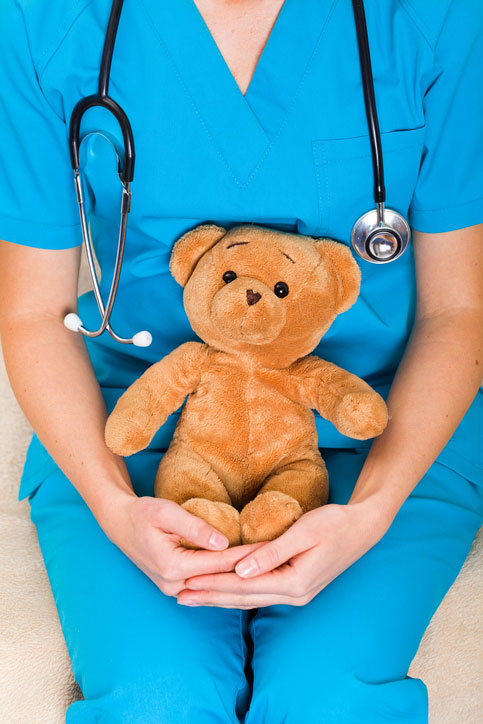
One large matter well-nigh working with kids all day is the excitement and sense of fun y'all go to bring to the job. Even though you're dealing with some very serious situations and often some very sick children, function of your job is keeping their mind off of those bug. You get to wear bright scrubs, bring blimp animals and drawing Bandaids on your rounds, and prescribe lollipops forth with codeine.
But you nonetheless spend a lot of the twenty-four hours doing nursing things… updating charts, monitoring equipment, making rounds, distributing medications, performing procedures. You lot communicate with colleagues, confer with specialists. Sometimes you will be on the telephone, coordinating belch and care plans, and other times you'll be in meetings.
What Are Pediatric NP Responsibilities and Duties?
Of course, your day on the job tin depend quite a scrap on what type of chore y'all are doing. Responsibilities and duties for NPs vary a lot based on specialization. That can make your 24-hour interval radically different from the typical NP.
Some of the more than common job duties for pediatric NPs can include:
- Neonatal care duties – Working with the tiniest, virtually vulnerable infants takes a lot of attention to detail. The role routinely requires:
- Monitoring vitals for NICU patients
- Educating and training families of premature infants in transitional and home intendance
- Keeping staff and families up on patient developmental progress
- Monitoring and adjusting specialized equipment like capnographs, bilirubinometers, and ventilators
- Developmental care duties – PNPs in development care offer support for kids with mental and physical disabilities. Their tasks tin include:
- Assisting in feeding and bodily functions
- Educating, preparation, and supporting parents in care for their kid
- Assisting with the evolution of language and communication skills, in coordination with specialists
- Prescribing, monitoring, and maintaining assistive equipment
- Palliative care duties – Working with terminally-ill children takes vast reservoirs of empathy and willpower. Only fulfilling these duties makes those last days better for both kids and their families:
- Communicating with families near patient condition and progression
- Analogous end-of-life care and processes with other specialists
- Monitoring concrete and mental states
- Managing pain past appropriately delivering medications
- Primary intendance duties – Treatment the day-to-day needs of ensuring a good for you generation means watching your patients grow from toddlers to teenagers. Main care involves the total range of challenges that come at every age, from offer inoculations to counseling kids nigh STDs
- Examine and note vital statistics and any unusual symptoms or developmental issues
- Continue accurate charting and monitor growth against standards for each age
- Handle handling of common childhood illnesses and injuries
- Brand referrals to outside specialists and coordinate care for patients
The Differences in Pediatric Primary Care Vs Astute Care Nurse Practitioner Jobs
There'due south a large divide in the pediatrics nursing world betwixt primary intendance and astute care roles.
- Primary Care – Chief intendance nursing focuses on long-term wellness and well-being through services such as health promotion, screening, education, and preventative procedures. They tend to keep regular schedules and appointments in hospitals, clinics, and doctor's offices.
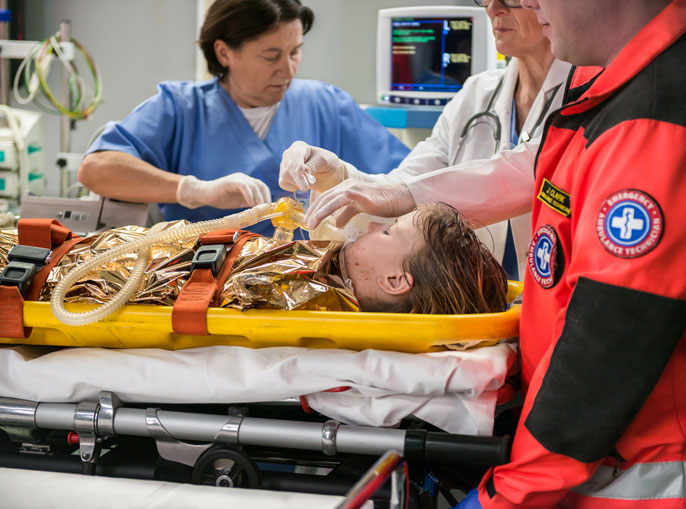
- Acute Intendance – Acute care nurses work with critical, immediate healthcare issues, handling some of the sickest patients in environments like intensive care units and emergency departments. They are most probable to work for hospitals or in skilled nursing facilities.
This divide is so central that the certifications for the two jobs are different, and even the degrees offered in each have very specialized classes.
Although official information doesn't differentiate betwixt the two types of jobs, some salary surveys find that astute care specialists tend to make more than money at any given level of experience. Considering the nature of acute care work and the hours involved, higher pay levels seem likely.
What is Work equally a Pediatric Oncology Nurse Practitioner Similar?
If you lot want to know what the hardest job in pediatric nursing is, yous don't have to ask around much to find the reply. Just about anybody agrees that pediatric oncology represents the toughest work in the nursing profession. Perchance it's the hardest thing in healthcare.
Cancer is an atrocious disease, the body tearing itself to pieces at the cellular level. It's hard to sentinel anyone suffering through it, but when it's kids, the built-in empathy and protectiveness we experience kicks in to overdrive.
Even worse for pediatric oncology NPs is the fact that some of the treatments for cancer tin can be nearly equally awful as the disease. To relieve those kids in your ward, you're going to accept to help poison them: chemic cocktails that devour cancer cells and at the same fourth dimension hair follicle cells. Radiation that zaps healthy cells and tumors without discretion. Information technology's heartbreaking, but it'south besides where the promise comes from. And having that hope in your easily can also exist a powerful feeling, one that makes the bad days worthwhile.
Facts and FAQs Almost Pediatric Nurse Practitioners
Yous're going to have a lot of questions near becoming a pediatric nurse practitioner. Here, y'all'll observe some answers to many of those most common questions.
What is the historic period range of patients treated by pediatric nurse practitioners?
Pediatric nurse practitioners treat patients from infancy through young adulthood. The specific telescopic of practise authorized for PNPs varies from state to state. In some cases, the cut off may be at ages 18 or 21, simply in other states, no specific number is determined. In full general, it's best for medical providers to agree on who tin offer the all-time care in whatever specific case.
Practise I demand a certification to practice as a pediatric nurse practitioner?
Yeah, in nigh every country you are required to hold a current certification from a recognized national credentialing body in gild to become licensed as a pediatric nurse practitioner. For pediatric avant-garde nursing practice, that ways a certification from the Pediatric Nursing Certification Lath.
What is the Pediatric Nursing Certification Board and why is it important for pediatric nurses?
PNCB is the only remaining profession certification torso covering the specific field of advanced practice pediatric nursing. Established in 1975, they have established a level of competence and expertise in evaluating skill levels of prospective PNPs that makes them widely recognized as the standard-bearer for professionals in this field.
What certifications are available for pediatric nurse practitioners?
PNCB offers two different certifications for pediatric nurse practitioners:
- Acute Intendance Certified Pediatric Nurse Practitioner (CPNP-AC)
- Principal Care Certified Pediatrics Nurse Practitioner (CPNP-PC)
Only like it appears, these advanced practice certifications split up between the kinds of knowledge and practices required in primary care versus acute care settings. Both require an MSN, DNP, or mail service-graduate certificate, 500 hours of direct clinical patient intendance hours, a current RN license, and passing a 175 multiple-pick question test. Your educational groundwork too has to align with the certification y'all are pursuing, either acute or master.
Y'all might already have, or might choose to get, a CPN (Certified Pediatric Nurse) from the lath also. It'southward available to any nurse, non just APRNs, but covers a great deal of practical pediatric nursing cognition.
Where do pediatric nurse practitioners piece of work?
According to the Bureau of Labor Statistics, most nurse practitioners work in the offices of physicians or general medical and surgical hospitals.
That definitely holds true for PNPs. The advanced skills required for the job are a good match to the demands of a pediatrics ward or for general pediatric practice. But you can also find jobs for PNPs in:
- Surgery centers
- Pediatrician's offices
- Community health centers
- Long-term care centers
- Convalescent care centers
How can I become a pediatric nurse practitioner?
Like all avant-garde practice registered nurses, PNPs have to go through avant-garde training on top of the regular nursing didactics needed by registered nurses. A master of science in nursing is a path to advanced practice licensure, with an accent in pediatrics, but y'all can also go for a doctorate in nursing.
Additionally, you have to written report topics such as:
- Pediatric development and behavior
- Pediatric disease direction
- Advanced health assessment and diagnostics
- Advanced pathophysiology
- Pharmacology
On top of that, you'll have courses that are unique to your sub-specialization in astute or principal pediatric intendance. And y'all'll as well accept part in practicum placements to requite you hands-on experience working with pediatric patients.
Can an online program qualify you as a pediatric nurse practitioner?
Aye, there are many excellent MSN and DNP programs that are conducted primarily online today with pediatric nurse specializations available. Of form, in healthcare, no plan is truly entirely online. Your easily-on field experience must notwithstanding be conducted in a local hospital or clinic. But all your coursework tin be completed through asynchronous, online classes that allow y'all the maximum flexibility in your schedule and location.
Can APRNs from a different specialization get pediatric nurse practitioners?
Yes, only you will accept to complete a post-primary's certificate program to get the same specialized coursework as ped NPs who come upwards through a dedicated MSN or DNP program. Merely similar those degree programs, you will take to cull betwixt acute and primary emphasis in pediatric advanced practice nursing. And just as with total degree programs, you can observe mail-master'south certificate options available online.
What are the admissions requirements for pediatric nurse practitioner MSN and DNP programs?
Admissions requirements are rigorous for PNP pedagogy tracks. In most cases, you will already demand to hold an RN license. Many programs also specify that you have 2 or more than years not just of nursing experience, only also in nursing feel specific to pediatric primary or astute care.
How much do pediatric nurse practitioners make?
Co-ordinate to the Bureau of Labor Statistics, the median annual salary for nurse practitioners in 2020 was $111,680. Those in the top 10 percent of the profession could bring home $156,160 or more than.
BLS doesn't split up the data to specifically encompass pediatric nurse practitioners. It's very likely their salaries are in line with the profession as a whole, or even slightly above the median due to the specialized nature of their preparation and practice area.
What is the function of pediatric NPs in a pediatric ward?
Working at a peds ward in a hospital environment ways you are working with some of the sickest and most vulnerable patients a pediatric nurse will ever have to bargain with. Advanced practice nurses accept more than advanced skills, which also means they have on more responsibleness for those patients. PICU and NICU nurses carefully monitor patients both through electronic sensors and by regularly checking them physically. They also take those opportunities to reassure and encourage their patients, who need that contact and intendance far more than adults. And pediatric ward NPs too perform the full slate of diagnostic testing and treatments needed for their patients.

What Is A Pediatric Registered Nurse,
Source: https://www.graduatenursingedu.org/pediatric-nurse-practitioner/what-does-a-pediatric-nurse-do/
Posted by: rubiosuppen.blogspot.com
0 Response to "What Is A Pediatric Registered Nurse"
Post a Comment